
Lead-Free Solder Paste: Alloys, Powder Types and Selection
A lead-free solder paste is defined by three choices: the alloy, the powder size and the flux. Get one wrong and you see it on the line as bridging, voiding, solder balls or cold joints, however good the other two are. This guide covers how each choice is classified, which combinations are standard, and what to check on a datasheet and certificate before you approve a new paste or a new supplier.
The Three Parts of a Solder Paste Specification
A complete lead-free paste specification reads something like "SAC305, Type 4, ROL0, 88.5% metal". Each element maps to a standard:
- Alloy: the composition of the metal powder, for example Sn96.5Ag3.0Cu0.5 (SAC305), defined under IPC J-STD-006.
- Powder type: the particle-size distribution of that powder, classified in IPC J-STD-005.
- Flux classification: the chemistry and activity of the flux vehicle, coded under IPC J-STD-004.
Buyers often specify only the alloy. Production engineers care just as much about the other two, because they decide whether the paste prints through your stencil and whether the residue can stay on the board.
Lead-Free Alloys Compared
| Alloy | Composition (wt%) | Melting point / range | Typical reflow peak | Main use |
|---|---|---|---|---|
| SAC305 | Sn96.5 Ag3.0 Cu0.5 | 217–220 °C | 235–250 °C | Default for general SMT |
| SAC0307 (low silver) | Sn99 Ag0.3 Cu0.7 | Higher and wider than SAC305 | Close to SAC305 or slightly higher | Cost-driven consumer assembly |
| Sn42Bi58 | Sn42 Bi58 | 138 °C | About 160–180 °C | Heat-sensitive parts, thin boards, step soldering |
| Sn63Pb37 (leaded reference) | Sn63 Pb37 | 183 °C | Roughly 35 °C below SAC305 | Exempt applications only |
Sources: SAC305 data from AIM Solder; Sn42Bi58 data from AIM Solder and Indium Corporation.
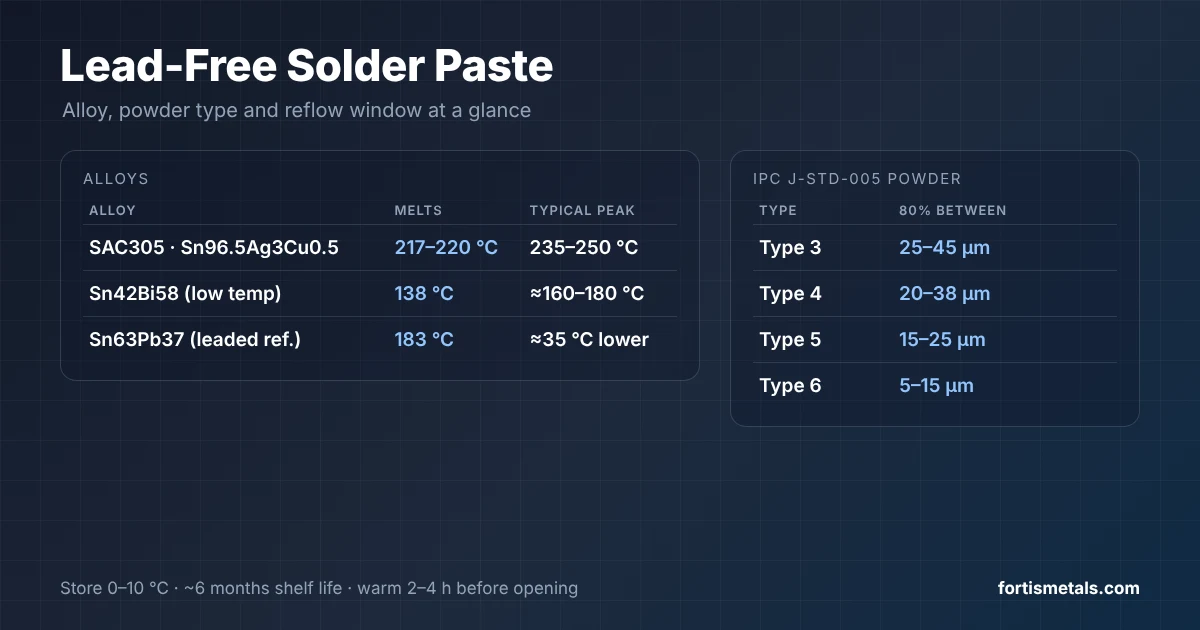
SAC305 is the reference alloy. It melts across 217 to 220 °C, and AIM gives a peak reflow range of 240 to 250 °C. Industry articles commonly quote 235 to 245 °C peaks for SAC alloys. Because lead-free alloys melt higher than SnPb, the profile has to be tuned so components and boards are not overheated, and the flux must not decompose before the alloy melts at 217 °C.
Low-silver SAC alloys such as SAC0307 exist mainly because of the silver price. Rising silver costs drove the development of many low- or no-silver alternatives, and published tests found many of them printed as well as SAC305. Expect a slightly higher liquidus and a less forgiving wetting window, and qualify thermal-cycling reliability for your product before switching.
Tin-bismuth (Sn42Bi58) is the main low-temperature option. It melts at 138 °C. Indium Corporation notes it can be reflowed at a peak of about 160 °C, more than 80 °C below a typical SAC305 peak. That protects heat-sensitive components and reduces board warpage. The trade-off is brittleness, and bismuth joints are less resistant to mechanical shock in drop tests. Avoid bismuth-containing pastes on components with lead-bearing terminations: after 1,000 hours at 150 °C, these joints showed more cracking.
Powder Type: Matching the Paste to Your Stencil
IPC J-STD-005 classifies solder powder by particle-size distribution. The defining band is the range in which at least 80% of particles must fall:
| IPC type | 80% of particles between | Mesh shorthand | Typical use |
|---|---|---|---|
| Type 3 | 25–45 µm | −325 / +500 | Standard-pitch SMT |
| Type 4 | 20–38 µm | −400 / +635 | Fine pitch, e.g. 0.5 mm QFP |
| Type 5 | 15–25 µm | −500 | Ultra-fine pitch, 0.4 mm CSP, small apertures |
| Type 6 | 5–15 µm | — | Microelectronics, very small deposits |
Source: particle bands adapted from Table 3-2 of IPC J-STD-005A, as reproduced by FCT Assembly.
The rule of thumb: finer powder prints through smaller apertures. Type 4 or 5 is common practice once stencil area ratios drop below the IPC-recommended limit of 0.66. Don't go finer than you need. Smaller particles have more surface area to oxidise, and Indium Corporation notes that a paste with a 6-month shelf life at Type 3 may not achieve the full 6 months with Type 6 powder.
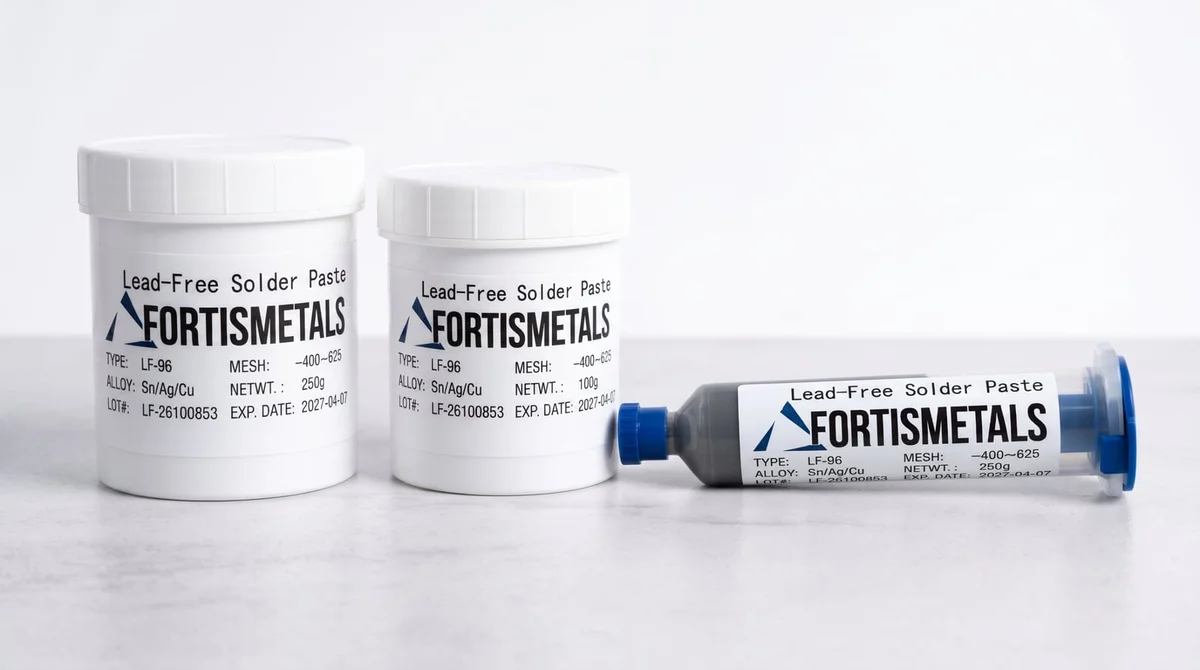
On a label, powder size is often given in mesh rather than type. The paste in the photo above is marked −400~625 mesh, meaning it passes a 400 mesh screen (about 38 µm) and is retained on a 625 mesh screen (about 20 µm). That puts it in the Type 4 band.
Flux Classification: Reading the J-STD-004 Code
IPC J-STD-004 assigns every flux a code built from three parts:
- Base material: RO (rosin), RE (resin), OR (organic) or IN (inorganic, not used in electronics).
- Activity: L (low), M (moderate) or H (high).
- Halide content: 0 (halide-free) or 1 (contains halide).
So ROL0 is a low-activity, halide-free rosin flux. ROL0 and ROL1 are the classifications most people recognise as no-clean, and a no-clean residue relies on the rosin encapsulating it and on proper heat activation during reflow. REL0 resin-based no-clean pastes are also widely used in high-volume SMT. OR fluxes are usually water-washable, but some rosin-free no-clean products also classify as OR, so check the datasheet rather than assuming from the code alone.
Decision rule: if the board will not be cleaned, specify a no-clean L0 or L1 paste and confirm surface insulation resistance (SIR) data for your reflow profile. If the assembly will be washed anyway, for example before conformal coating, a water-soluble paste designed to be cleaned off is the usual choice.
Storage, Shelf Life and Handling
Solder paste is a perishable product, and most quality problems blamed on the paste are really handling problems.
- Refrigerate on arrival. Long-term storage should be at 0 to 10 °C. Some pastes must not be frozen. Follow the datasheet.
- Know the shelf life. Typical no-clean paste shelf life is 6 months, and water-soluble paste ranges from 3 to 6 months, counted from the date of manufacture, not the date of delivery. Check the expiry date on the label (the jars pictured show both lot number and expiry date).
- Warm up before opening. Let sealed containers reach room temperature first, typically at least 2 hours and up to 4 for large containers. Never heat paste above 25 °C to speed this up. Opening cold paste causes condensation, which leads to spattering, solder balls and voids.
- First in, first out. Paste ages in storage, so rotate stock by manufacturing date.
RoHS: Why Lead-Free Is Required and Where Lead Is Still Allowed
Under the EU RoHS Directive (2011/65/EU), lead is limited to 0.1% by weight in homogeneous materials. Annex III lists exemptions, the most important for solders being 7(a), which allows lead in high-melting-temperature solders containing 85% or more lead by weight. According to SGS, the general 7(a) exemption expires on 30 June 2027, and the European Commission adopted a delegated directive on renewing it in September 2025. If you still build with high-lead die-attach or similar solders, confirm which sub-entry of 7(a) covers your application and its expiry date.
For everything else in scope, specify a lead-free paste and ask for a declaration of RoHS conformity with the material.
Buyer's Checklist for Lead-Free Solder Paste
When qualifying a paste or a new supplier, ask for:
- Alloy composition with an assay or certificate of analysis per lot, including lead content to show RoHS compliance
- Powder type per J-STD-005 and particle-size distribution data
- Flux classification per J-STD-004, with SIR and electrochemical migration test results
- Metal content (% by weight) and viscosity
- Recommended reflow profile, stencil life and tack time
- Storage temperature, shelf life from manufacture, and expiry date on every container
- Packaging options: jars for stencil printing, syringes or cartridges for dispensing
Frequently Asked Questions
Lead-Free and Leaded Solder Paste from Fortis Metals
Fortis Metals supplies lead-free and SnPb solder alloys, solder paste and solder preforms, as well as the bismuth and indium used in low-temperature alloys. For low-temperature work, see our guide to low melting point alloys and our indium-based lead-free solder article. Send us your alloy, powder type, flux classification, packaging and monthly volume through our contact page, and we will propose a matching specification with certificates.