
Ruthenium vs Iridium: Properties, Uses and Buying Guide
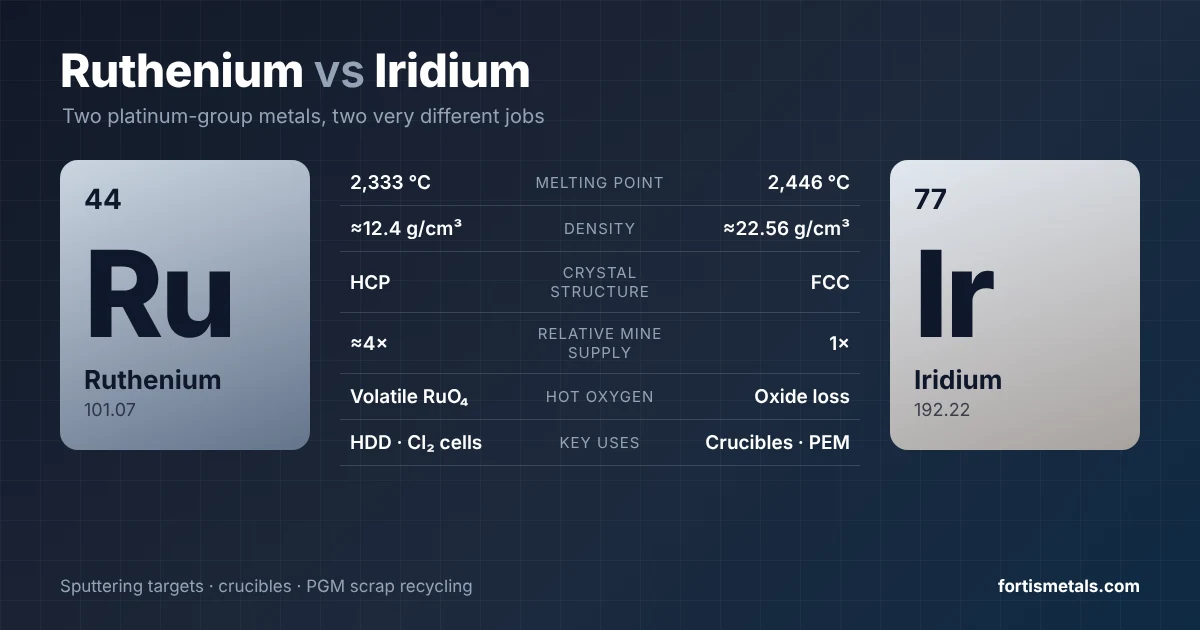
Ruthenium vs iridium is a question we hear from two kinds of people: engineers choosing a material for a thin film, electrode or crucible, and buyers trying to understand why two "similar" platinum-group metals behave so differently in price and availability. Both are hard, brittle, extremely corrosion-resistant metals recovered as by-products of platinum mining. That is roughly where the similarity ends.
This guide compares them on the points that decide real projects: physical properties, behaviour in oxygen at temperature, the applications where each one is hard to replace, how they are supplied and priced, and what to put on a purchase specification.
Ruthenium vs Iridium at a Glance
| Property | Ruthenium (Ru) | Iridium (Ir) |
|---|---|---|
| Atomic number | 44 | 77 |
| CAS number | 7440-18-8 | 7439-88-5 |
| Melting point | 2,333 °C | 2,446 °C |
| Density at room temperature | about 12.4 g/cm³ | about 22.56 g/cm³ |
| Crystal structure | Hexagonal close-packed | Face-centred cubic |
| Workability | Hard and brittle; usually made by powder metallurgy, arc or electron-beam melting | Hard and brittle; difficult to machine and form |
| Behaviour in hot oxygen | Forms volatile RuO4 | Oxides evaporate at crystal-growth temperatures |
| Main end uses | Hard disk drives, chip resistors, chlor-alkali electrode coatings, catalysts, thin films | Crystal-growth crucibles, PEM electrolyser anodes, spark plug tips, electrochemical coatings |
| Relative mine supply | Roughly 4x iridium | About a quarter of ruthenium's |
Sources: melting points from the Royal Society of Chemistry and Los Alamos National Laboratory; supply ratio from published PGM market data.
Two numbers matter most in practice. Iridium is almost twice as dense as ruthenium, so the same part or target volume needs far more iridium by weight, which compounds its higher price per ounce. And ruthenium mine production is roughly four times that of iridium, which is why the industry substitutes ruthenium for iridium wherever performance allows.
Oxidation: Where Each Metal Fails
Both metals resist acids extremely well at room temperature. Iridium is not attacked by any acid, including aqua regia, although molten salts such as NaCl and NaCN do attack it. The real dividing line is hot oxygen.
Ruthenium oxidises to RuO2, and in an oxygen-rich atmosphere RuO2 reacts further to form ruthenium tetroxide (RuO4), a volatile and toxic compound. Equilibrium studies by US national laboratories measured this RuO2 to RuO4 reaction between 453 and 723 °C. In practice this means ruthenium metal should not be used in hot, oxidising service where mass loss or vapour release matters. Furnaces that process ruthenium scrap or powder need proper extraction for the same reason.
Iridium tolerates higher temperatures, but not unlimited oxygen. Crucible makers rate iridium crucibles for use up to about 2,300 °C for growing high-melting oxide crystals such as sapphire and spinel, but should be run under inert conditions where possible because iridium oxides evaporate and cause considerable weight loss. Crystal growers therefore control oxygen partial pressure carefully. Too little oxygen creates vacancies in the crystal, while too much attacks the crucible.
Decision rule: for oxidising atmospheres at high temperature, neither metal is the default choice. Platinum or platinum-rhodium usually is. Choose iridium when the melt is too hot for platinum and the atmosphere can be kept inert or only slightly oxidising. Avoid bare ruthenium in hot oxidising environments.
Where Ruthenium Is Hard to Replace
Hard disk drives. Ruthenium is used in the magnetic layers of HDD media, as a film thinner than a nanometre that allows higher recording density. Data-centre build-out for AI has made this the main growth driver for the metal. Reuters reported in March 2026 that ruthenium hit an all-time high, at around $1,750 per ounce compared with about $560 a year earlier, citing LSEG data.
Chip resistors and contacts. Ruthenium oxide based thick-film pastes are standard in chip resistors, and ruthenium hardens platinum and palladium for wear-resistant electrical contacts.
Chlor-alkali and catalysis. Ruthenium oxide coats the dimensionally stable anodes used in chlorine production, and ruthenium catalysts are used in ammonia and acetic acid production.
Advanced semiconductor interconnects. Ruthenium first entered fabs as a liner material because it blocks copper diffusion as well as TaN while giving lower net resistance. At line widths below roughly 10 nm, copper loses its resistivity advantage. Ruthenium needs no barrier layer, so it is the leading candidate to replace copper at the tightest metal levels of future logic nodes (Semiconductor Engineering). Volumes are small today, but purity requirements for these films are among the strictest in the industry.
Where Iridium Is Hard to Replace
Crucibles for crystal growth. Iridium is one of the few metals pure and refractory enough to contain oxide melts above platinum's limit, in Czochralski and Bridgman growth of laser and optical crystals. For bismuth germanate (BGO) scintillator crystals, a patent study found iridium far more chemically neutral than platinum towards the melt, with no major source of contamination. Iridium is costly, so crucibles are routinely reclaimed and refabricated rather than scrapped.
PEM electrolysis. The anode of a PEM water electrolyser runs in a highly acidic, oxidising environment, and iridium or iridium-based catalysts are currently the only feasible choice for commercial systems. Research has pushed anode loadings down from the traditional 1 to 3 mg of iridium per cm² towards 0.1 to 0.4 mg/cm². Johnson Matthey expects iridium demand to rise in 2026 as two large European green hydrogen projects use iridium at commercial scale in PEM electrolysis.
Spark plugs and electrodes. Fine-wire iridium tips are standard in long-life spark plugs. Some manufacturers now offer ruthenium-tipped plugs, a sign of the general trend of substituting ruthenium where it performs well enough.
Magnetic thin films. IrMn alloys are a common antiferromagnetic pinning layer in magnetic tunnel junctions for MRAM and read heads, deposited by sputtering from IrMn alloy targets or co-sputtering from separate iridium and manganese targets.
Sputtering Targets: Ruthenium vs Iridium
Both metals are widely used as sputtering targets, and the buying questions are similar:
- Purity and certificate of analysis. 3N5 to 4N is common for many thin-film uses; semiconductor and media customers often require higher purity with a full GDMS impurity report covering alkali metals, iron, nickel, and radioactive elements where relevant. Ask which elements are reported, not just the total purity.
- Density and microstructure. Both metals are usually made by powder metallurgy (hot pressing or HIP). Relative density, grain size and oxygen content drive arcing, particle generation and film uniformity.
- Bonding and backing plate. Brittle PGM targets are almost always bonded to copper or molybdenum backing plates. Specify the bond type (indium or elastomer) and the maximum power density you run.
- Reclaim. A large share of a planar target's metal is still left when it reaches end of life. At current ruthenium and iridium prices, agree on spent-target return and credit terms when you place the order.
Fortis manufactures ruthenium and iridium sputtering targets and reclaims spent targets. Our ruthenium sputtering targets guide covers ruthenium target specifications in more detail.
Supply, Pricing and Market Outlook
Both metals are mined almost entirely as by-products of platinum and palladium production, so supply cannot respond quickly to demand. South Africa is the largest producer, followed by Russia and Zimbabwe, and ruthenium is recovered commercially from nickel-refining residues. This is the main supply risk for both metals: a mine disruption in South Africa affects them together.
Neither metal has a major futures exchange. Prices are quoted in US dollars per troy ounce, through producer and dealer price quotes such as Johnson Matthey's base prices, and actual deals are negotiated between refiners, fabricators and users. Expect wider bid-offer spreads and sharper moves than in platinum or palladium.
The 2026 picture, according to the Johnson Matthey PGM Market Report (May 2026), is that both ruthenium and iridium will remain in deficit:
- Ruthenium: demand is forecast to fall about 6% as chemical-sector use weakens, but strong HDD demand from data centres keeps the market in a significant deficit.
- Iridium: demand edges higher on PEM electrolysis while supply stays stable, leaving a modest deficit.
Metals Focus, in its own 2026 outlook, forecast average prices more than doubling to about $1,560/oz for ruthenium and rising 64% to about $7,200/oz for iridium. Treat these as forecasts, not quotes, and check current levels before budgeting.
Choosing Between Ruthenium and Iridium
| If your application is… | Usually choose | Why |
|---|---|---|
| Crucible for oxide melts above about 1,700 °C under inert atmosphere | Iridium | Higher melting point and chemically neutral toward many oxide melts |
| Crucible in air or oxidising atmosphere | Platinum or Pt-Rh (neither Ru nor Ir) | Iridium oxides evaporate; ruthenium forms volatile RuO4 |
| PEM electrolyser anode catalyst | Iridium (or Ir-Ru mixed oxide where durability allows) | Only proven stable oxygen-evolution catalyst in acidic conditions |
| Chlor-alkali anode coating | Ruthenium oxide (often with iridium) | Industry-standard dimensionally stable anode chemistry |
| HDD media interlayer, chip resistors | Ruthenium | Established process window and lower cost per unit volume |
| Antiferromagnetic pinning layer (MRAM, read heads) | Iridium (as IrMn) | Strong exchange bias and corrosion resistance |
| Lowest metal cost per part | Ruthenium | Lower density and larger supply than iridium |
Frequently Asked Questions
Sourcing Ruthenium and Iridium from Fortis Metals
Fortis Metals supplies ruthenium and iridium as metal and powder, manufactures ruthenium and iridium sputtering targets, supplies iridium crucibles, and recycles spent targets and PGM scrap through our metal refining service. Send us your required form, purity, dimensions and annual volume through our contact page, and we will come back with a specification and quotation.