
Sputtering Target Manufacturers: How to Evaluate a Supplier
Two sputtering targets can carry the same purity on the label and still give you very different films. The difference sits in things a datasheet rarely shows: how the purity was measured, how dense the target is, how its grains are arranged, and how it is bonded to the backing plate. This guide sets out what to check when you qualify a new sputtering target manufacturer. The goal is to catch problems at the incoming inspection, not after particles show up on your wafers or panels.
What You Are Really Buying
A sputtering target is a production consumable whose quality shows up in every film it deposits. Its composition, purity and microstructure decide the quality and consistency of that film over the whole life of the target. The market is substantial and growing. TECHCET, the electronic materials advisory firm, projected semiconductor sputtering target revenues to grow nearly 9% in 2025 to about $1.45 billion, before counting display, solar, data-storage and optical coating demand.
For a buyer, that means three questions: will the target perform on day one, will the next lot perform the same, and what happens to the metal left over at end of life?
The Supplier Scorecard
| Criterion | What good looks like | How to verify |
|---|---|---|
| Purity | Stated grade (e.g. 4N, 5N) backed by a full impurity analysis | Lot certificate by GDMS, with gases by combustion analysis |
| Relative density | ≥98–99% of theoretical for metal targets | Measured density on the certificate |
| Grain size and texture | Fine, uniform, no banding through the thickness | Metallography report or sample section |
| Bonding | Bond type matched to your power density | Bond coverage report (ultrasonic C-scan) |
| Backing plate | Correct alloy, flatness and cooling geometry for your cathode | Drawing approval before production |
| Traceability | Lot number linking raw material, target and certificate | Sample certificate before ordering |
| End of life | Defined reclaim or credit terms for spent targets | Written in the purchase agreement |
1. Purity: Ask How It Was Measured
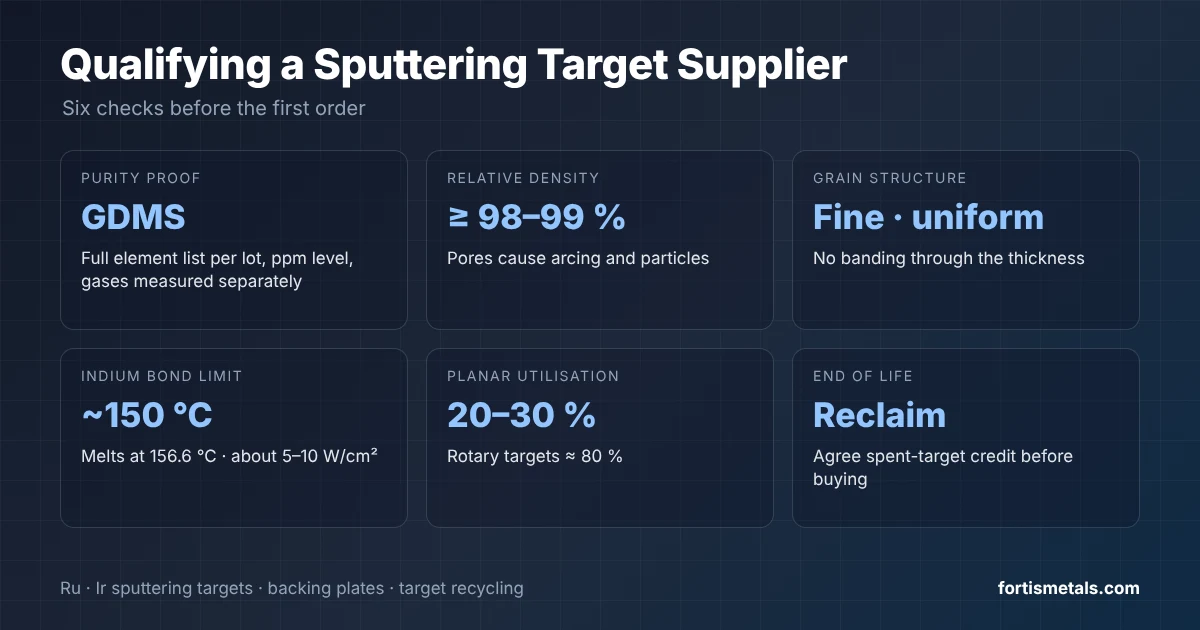
"99.999%" means total impurities of no more than 10 ppm, but only if every relevant element was measured. A purity figure "by difference" from a short element list says little.
Glow discharge mass spectrometry (GDMS) is the industry standard for high-purity metals. Canada's National Research Council describes it as the standard method for high-purity materials, with detection at parts-per-billion level in a single run. GDMS analyses the solid directly, avoiding the dissolution steps needed for ICP-MS. ASTM F1710 is an example of a GDMS method written specifically for the semiconductor industry to evaluate materials such as sputtering targets. At the top end the numbers get very small: in 6N copper, the sum of all impurities is only 1 ppm.
A good certificate lists dozens of elements individually in ppm, often down to thorium and uranium at 0.001 ppm, with carbon, nitrogen and oxygen measured separately by combustion or inert-gas fusion analysis. If a supplier cannot show you a certificate like that for a recent lot, treat the purity claim as unverified.
Ask specifically about: alkali metals (sodium, potassium) for semiconductor gate and interconnect layers, iron, nickel and cobalt for magnetic stacks, oxygen and carbon in refractory and precious-metal targets, and uranium and thorium for memory applications.
2. Relative Density: The Main Cause of Arcing
Relative density is the target's measured density as a percentage of the theoretical value for the bulk material. Pores are where problems start. Patent literature on Mo-W wiring targets describes the mechanism: sputtered material builds up on pore edges into protrusions, which trigger abnormal discharges (arcing) and throw particles onto the substrate. The same document sets a minimum relative density of 98%.
The effect is easy to measure. In one tested target material, a sample at 93.5% relative density showed many arcing events, while samples at 95% and above sputtered stably. Many target specifications in the patent literature now call for 99% or more.
Decision rule: for metal targets made by powder metallurgy (common for ruthenium, iridium, tungsten and many alloys), ask for measured density on every lot and set your acceptance limit in the purchase specification, typically 98% to 99% or higher depending on the material.
3. Grain Size and Texture: Uniformity Over the Target's Life
Grains with different crystal orientations sputter at different rates. As a coarse-grained target erodes, the surface becomes uneven, and the steps between grains become new sources of particles. Banding in grain size or texture through the thickness is particularly harmful, because the sputter rate and film uniformity then drift as the target wears.
Targets for demanding applications are specified accordingly. One patented copper interconnect target, for example, calls for grain size below 10 µm to improve uniformity and reduce arcing. You will not always need that level. You do need a supplier who can tell you the grain size and show that it is consistent through the full thickness.
4. Bonding and Backing Plates
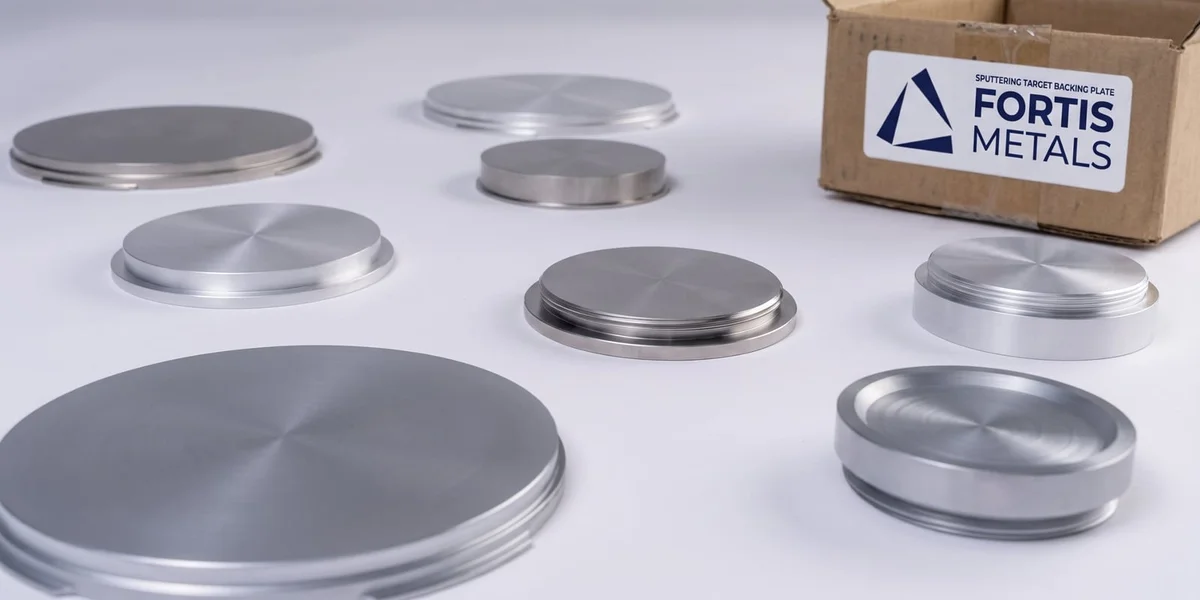
Most targets, and almost all brittle ones such as ceramics, ruthenium and iridium, are bonded to a backing plate that carries cooling water and mounts in the cathode. Backing plates are commonly copper, aluminium or one of their alloys. The photo above shows typical machined backing plates in several sizes.
The bond decides how much power you can run:
| Bond type | Strengths | Limits |
|---|---|---|
| Indium solder | Excellent heat transfer, simple, can be debonded and reused | Indium melts at 156.6 °C, so bonds fail above about 150 °C; power density typically limited to about 5–10 W/cm² |
| Elastomer | Higher temperature tolerance than indium | Lower thermal conductivity; must be fully cured to avoid outgassing in vacuum |
| Monolithic or diffusion-bonded | No low-melting layer; suited to high power | Higher cost; not possible for every material pair |
Sources: indium melting point and bond failure temperature from bonding service literature; power-density limit from US patent literature on target bonding.
A bond that only covers part of the interface creates hot spots and debonding, even within these limits. Ask for an ultrasonic C-scan or bond coverage report for every bonded target, and agree the acceptable void percentage in advance.
Decision rule: if your process runs high power or your cooling is marginal, do not accept an indium bond by default. Discuss elastomer or monolithic designs with the manufacturer.
5. Utilisation and End-of-Life Value
A planar magnetron erodes the target in a narrow "racetrack" groove, and the target must be changed when the groove nears the backing plate. Patent literature puts planar target utilisation at roughly 20% to 30% of the material, sometimes as low as 15%. Rotary (cylindrical) targets spread the erosion and are commonly quoted at around 80% utilisation, which is why display, solar and glass coating lines use them.
For inexpensive metals, the leftover material matters little. For ruthenium, iridium, platinum, gold, silver, indium or ITO, the spent target can still hold most of the metal you paid for. Precious-metal target makers often credit a returned spent target against the next order. Agree this before you buy: the credit basis (assay of the returned target, metal price on which date) and the payment terms.
Questions to Ask Before You Place the First Order
- Which purity grades do you produce, and can you send a recent GDMS certificate for this material?
- What relative density do you guarantee, and is it measured on each lot?
- What is the grain size, and how do you control uniformity through the thickness?
- Which bond types do you offer, and what maximum power density do you recommend for each?
- Do you machine backing plates to our drawing, or reuse and re-bond our existing plates?
- Do you offer reclaim or credit for spent targets, and on what assay basis?
- Which quality system do you work under, and can raw materials be traced to each target?
Frequently Asked Questions
Sputtering Targets and Reclaim from Fortis Metals
Fortis Metals manufactures ruthenium and iridium sputtering targets, supplies high-purity metals for target production, and recycles spent sputtering targets, including ITO, through our metal refining service. For material-specific guidance, see our ruthenium sputtering targets guide, our comparison of ruthenium vs iridium and our overview of sputtering target applications. Send us your material, purity, dimensions, bond type and drawing through our contact page.